
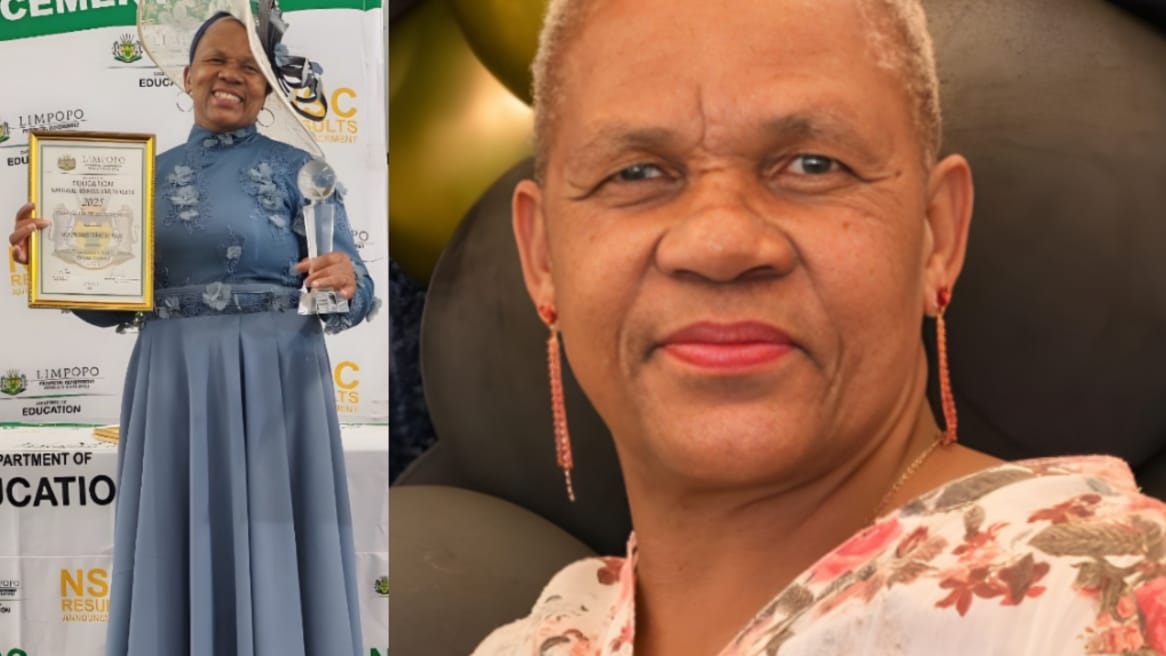
Principal Ramokone Molepo led Setotolwane Elsen Secondary School through years of severe infrastructure challenges, producing national top achievers against the odds. Picture supplied.
Struggling to write in Braille
inside overcrowded mobile classrooms with no ventilation, freezing in winter
and unbearably hot in summer, has been a daily reality for blind pupils at
Setotolwane Elsen Secondary School in Limpopo for years. The school caters for
deaf and blind children.
Built from corrugated iron, the
structures become extremely hot during summer and bitterly cold in winter.
Their hands would sweat when it was hot, and in winter their hands would be
frozen, making it difficult to write in Braille.
During particularly cold days,
teachers had no choice but to move lessons outside. They would make learners
sit under a tree so that they could be warmed by the sun during lessons.
Watching learners endure these
conditions was difficult for principal Ramokone Molepo and her team, but it
became a driving force for them.
Molepo said:
“This challenge was beyond my capabilities. The makeshift classrooms at the school, lack of resources, and the aging support personnel that were not replaced were serious concerns. Our classrooms consisted only of mobile classrooms. In these classrooms, there is no ventilation and they are overcrowded. During winter, they were cold, which made it difficult for blind learners to read and write Braille with ease, and in summer, they were hot.”
Despite these harsh conditions,
the blind pupils consistently produce strong results. In the past four years,
they were honoured at the national and provincial matric top achievers awards.
This year, Doris Ntjakata achieved second position at the national matric top
achievers’ awards and first position at the provincial awards ceremony.
READ: Partially sighted Limpopo learner
recognised at national matric awards by Basic Education minister
Molepo’s journey at Setotolwane
Elsen Secondary School began in April 2016, when she was seconded from Siloe
School for the Blind as a caretaker principal. Established in 2001, the school
had long struggled to perform, a situation she said “made the Department of
Education leaders have sleepless nights”.
Molepo said:
“When I was seconded there, I was a bit sceptical as I asked myself what difference I was going to make after 15 years of non-performance.”
Coming from a primary school
background, Molepo admitted she was uncertain about leading adolescent
learners. But her passion for deaf and blind learners ultimately guided her
decision. “I prayed to God to give me wisdom to use the acquired skills to make
a difference in the lives of those learners,” she said.
One of her first actions was to
redefine the school’s direction. “The first thing that I did on my arrival was
to redraft the vision of the school and come up with ways to accomplish it.”
This was followed by
presentations to the school governing body and staff to secure approval and buy
in, before listing existing problems and reviewing school policies to address
them.
Change did not come easily. “When
I started enforcement of policies, I got resistance from both educators and
learners. But through perseverance and relationship building, I overcame the
pushback. I constantly worked on building bridges with them for connectivity. I
was determined to fight those challenging situations and to deal with
criticism.”
READ:
Despite limited infrastructure
and resources, Molepo focused on building staff morale and accountability. “I
ensured that I was able to inspire, motivate, and give a sense of purpose and
direction to my staff. I encouraged them to be their very best and created a
strong morale throughout the school. I enabled the staff to take ownership of
outcomes.”
Her approach to learner
performance was equally structured. “The secret of my learners’ performance is
that I hold them accountable. At the beginning of each term, they pledge the
percentage they are going to obtain for each subject. At the end of the term,
together, we compare the actual performance and their pledge, and they account
for not reaching their targets. I also instilled in them academic discipline
and provided robust support systems that nurture their growth and learning. I
create a structured environment for them to produce the desired results,” said
Molepo.
As she prepares for retirement in
March after her 45 years of teaching, Molepo said she feels a mix of emotions
"A feeling of leaving my deaf and blind learners in the lurch and of
excitement, as I feel it is time to begin the next chapter of my life. After
these rewarding years, I leave a legacy of career accomplishment and service to
learners who are differently able.”
Reflecting as both an educator
and a mother, she described her learners’ achievements as the greatest gift she
could receive. “As a mother, I am really over the moon that my learners did not
drop the ball, and this is the best present they could give me for my
retirement. I am bowing out with pride, knowing that I did everything I could
do to influence the young minds.”
Her message to fellow leaders is
one of humility and collaboration.
Molepo said:
“As a leader, one does not know everything. One needs to recognise the valuable contributions of fellow workers, be visionary, inspirational, and be able to motivate and support their team members.”
If you wish to republish any of our stories, please credit the authors and the publication — www.thedeafdiary.com — and include the URL of the original story to direct readers to the source.